.svg)
Finden Sie jede Schwachstelle, bevor ein Angreifer es tut.
Durchgeführt von einem Team, ausgew?hlt aus über 800 White-Hat-Hackern weltweit, peer-reviewed von unabh?ngigen Auditoren und ausgerichtet an den Compliance-Frameworks, die Sie erfüllen müssen.
Globale Marken, die 色情聊天网站 vertrauen

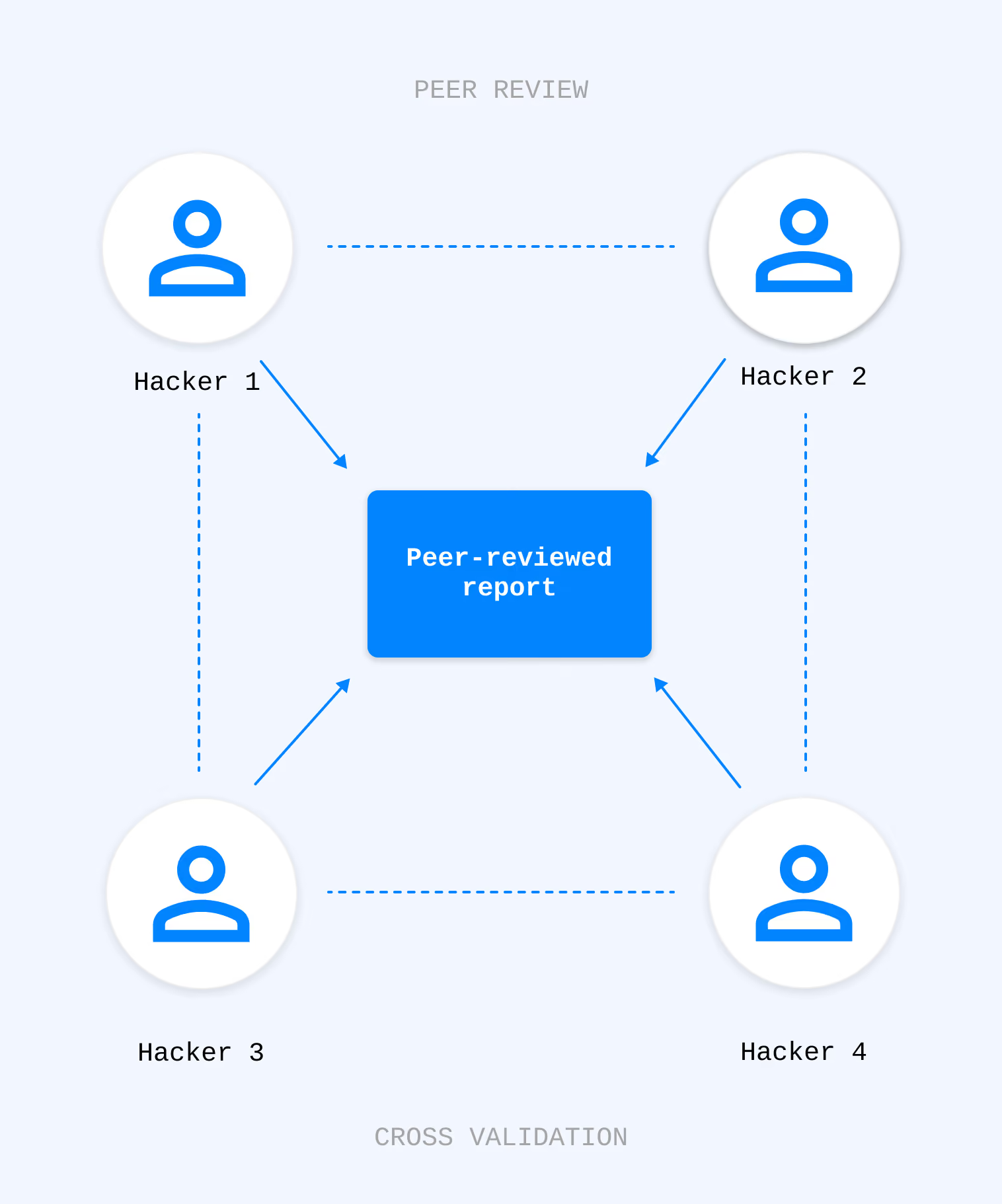
Die meisten Pentest-Firmen entsenden einen Tester. Wir entsenden vier.
Das Ergebnis: deutlich breitere Schwachstellenabdeckung, weniger falsch positive Ergebnisse und Befunde, die von mehr als einem Experten validiert wurden, bevor sie überhaupt Ihren Posteingang erreichen.


Was wir testen.


Zahlen Sie für das, was wir finden. Nicht für das, was wir nicht finden.
So oder so bleibt der Anreiz derselbe: jedes reale Problem finden, es ordentlich dokumentieren und den Bericht nicht mit unn?tigem Rauschen aufblasen. Jeder Befund durchl?uft ein Peer-Review, bevor er in Ihre Rechnung oder Ihren Bericht aufgenommen wird.

Von der Anfrage zum Abschlussbericht in 2 bis 4 Wochen.

Our pentesters carry the certifications that matter.
OSCE
OSWE
OSCP
CRTO
eCPPTv2

eCXD
CRTP

Burp Suite

Reports written to be accepted.
Information Security
Trust Services Criteria
Cardholder Data Environment
EU Digital Operational Resilience
EU Cybersecurity Directive
Healthcare & Privacy

What clients say.


FAQs

Three things help most: a clear scope document listing the assets to be tested, a test environment isolated from production where possible (or a maintenance window if production is in scope), and an internal point of contact who can respond to questions during the engagement. For Web3, share the repository commit hash you want tested and any deployment addresses. For AI/LLM systems, share the system prompt and any RAG sources. We provide a scoping checklist after the first call.
Most engagements run 2 to 4 weeks end-to-end. A small single-application scope can close in 1–2 weeks. A complex multi-environment engagement (web + API + cloud + AD) typically takes 3–4 weeks of testing followed by 3–5 days of peer review and consolidation. Smart contract audits are scoped by code complexity rather than duration — we quote both.
A fixed-floor base fee covering the scoping, four auditors' base time, peer review, and report production — plus a per-finding bonus weighted by severity (Critical / High / Medium / Low / Informational, CVSS 3.1). The bonus structure is disclosed in your quote so you can model the upper bound. In practice, engagements typically land 10–30% below the cap because not every codebase has a long tail of medium and low findings. You can also use our for an indicative range.
For web and infrastructure: PTES (Penetration Testing Execution Standard) and OWASP testing guides as the backbone, MITRE ATT&CK for adversary emulation when relevant. For mobile: OWASP MASVS and MSTG. For APIs: OWASP API Security Top 10. For smart contracts: a hybrid of SWC Registry, Trail of Bits' "Building Secure Contracts", and our internal Web3 checklist. For AI/LLM systems: OWASP LLM Top 10 and MITRE ATLAS. The applicable methodology is named in your engagement letter and your final report.
Yes. Our reports are written to the format that ISO 27001 certification bodies, SOC 2 CPA firms, PCI QSAs, and DORA-supervisory authorities expect to receive. They include executive summary, methodology, scope, findings with CVSS scoring and remediation guidance, evidence appendices, and retest verification of closed items. If your specific auditor has a custom format requirement, share it during scoping and we will accommodate.
Yes, for findings remediated and resubmitted within 30 days of the preliminary report. The retest specifically verifies closure of the reported issues — it is not a fresh end-to-end engagement. If new functionality has been deployed since the original test and you want it covered, that is a scope extension at the per-finding bonus rate (without the fixed base fee).
Yes, separately from standard pentesting. Red-team engagements have different scoping, longer timelines (typically 4–8 weeks), and a different deliverable focus (blue-team detection and response capability) compared to vulnerability-focused pentests. For DORA TLPT and TIBER-EU engagements specifically, ask for our threat-led testing brief.
It is escalated to your engagement point of contact within hours, not weeks. We do not sit on critical findings until the final report. You receive a preliminary write-up with reproduction steps and an immediate mitigation recommendation so your team can act before the testing window even closes.

The next vulnerability in your stack is already there. The only question is who finds it first.
?ber das Unternehmen
Im Zentrum dieser Mission steht unser TIC OS (?Testing, Inspection & Certification Operating System“) für Zertifizierungsstellen. Dieses spezialisierte KI-native ERP-System bildet die grundlegende Infrastruktur für den gesamten Sicherheits-Lebenszyklus, automatisiert komplexe Arbeitsabl?ufe und gew?hrleistet institutionelle Zuverl?ssigkeit. Anstatt ein Audit als statisches Ereignis zu betrachten, erm?glicht unser KI-natives Betriebssystem einen modularen, ganzheitlichen Ansatz für die Integrit?t von Projekten.
Durch die Verbindung fortschrittlicher Technologie mit fundierter menschlicher Expertise setzt 色情聊天网站 den Ma?stab dafür, wie Vertrauen in der dezentralen Wirtschaft aufgebaut und erhalten wird.
%201.svg)
Newsletter
